
OPERATION CHOKEPOINT 2.0
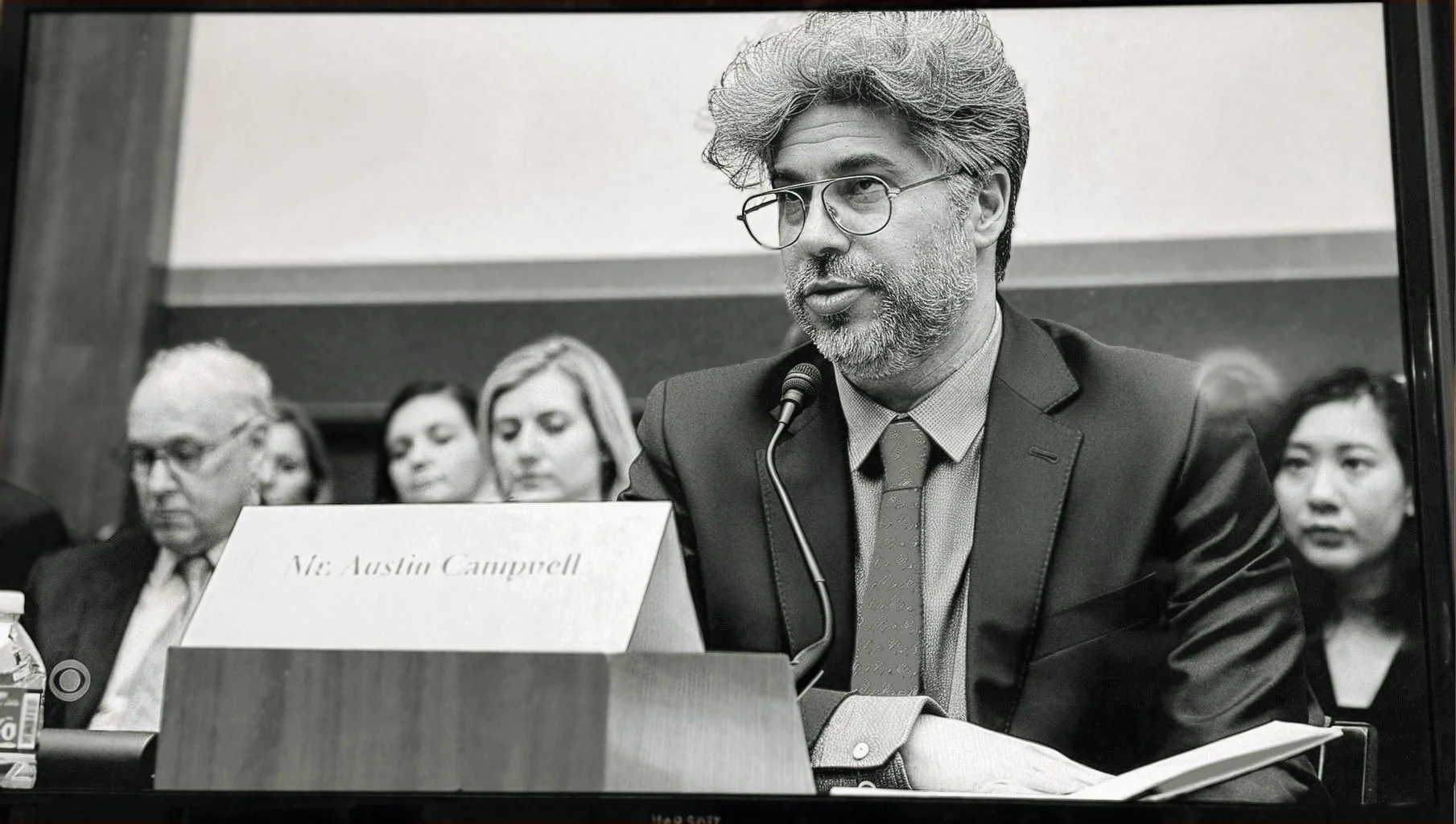
Source: U.S. House of Representatives / House Financial Services Committee
CALLING oN CONGRESS
Testifying is a strange experience. The hearing chambers for the House Financial Services subcommittee in Rayburn are these old wood-paneled side rooms. The staff store us here, like human cargo, before the hearing begins. This time, I was sitting with Paul and Fred whom I had never met before prior to this hearing, chatting about what we thought was going to happen. Paul was meticulously prepared, sporting a binder with tags and with every single tidbit of information categorized, organized, and ready to go. If you've seen Coinbase's legal work in fighting the Biden-era SEC, this is not totally surprising, but it is a legalistic type of terrifying to witness in person. Fred, on the other hand, was a bit more relaxed. He had the vibe of someone who had been there before, with a typed statement prepared and his staff having fully prepped him. Let me just say it was apparent that Fred is a CEO who has had to face down investors, the press, and adversarial audiences before. Meanwhile, I am, well, me. Which is to say, a college professor who stumbled around in industry for a while first, giving me both perspective but also a certain institutional level of not doing things the way most people would. I don't do written statements. I just can't. Reading off them feels so incredibly stilted to me after years on a trading desk having to shoot from the hip and then teaching. If you watch my opening statement, I have a notebook in front of me with bullet points that I want to cover, but I am ad-libbing that whole thing. I practiced, of course, in my own way sculpting the general arguments and coming up with some good turns of phrase. When I have to do it, though, I just let it ride.
When it's time to start, you are escorted out into the main hearing room, where you have a set of small tables with comically small water bottles provided, just to really drive home the effect at which they seat all the witnesses next to each other. The seating for the members of Congress are elevated in front of those tables, so they are literally looking down at the witnesses. Then, around the sides and back of the room, are the staff, usually underpaid, overworked, and managing 12 things at once just to keep any of this moving forward at all. Members of Congress sometimes come in and out along with their staff during the hearing, rushing between various appointments. Perhaps they are deeply, deeply informed and come in with granular, precise questions, critiques, or framings. Perhaps, well, not so much. I'll be polite, given the venue. After all, the entirety of the proceedings will be broadcast on the most riveting news channel C-SPAN. What you see on TV is the real thing, though you all sit down, and just roll for two hours, with no break, and whatever happens happens. Despite the mild absurdity of the whole situation, the topic on which we were testifying about this time around was deadly serious.
One of the few things more annoying than having a bank account is not having a bank account. If this happens because you are a genuine criminal, or because you have made yourself so difficult and painful for the bank to deal with that they'd rather just not, so be it. I don't love that such a thing can happen, but it's not an affront to the system for this to happen. On the other hand, if you can't get services because the bank is a bunch of racists, because the government said banks aren't allowed to serve you, or because banks have decided to form a cartel so you can't compete against them, that would be, to use a term of art, complete bullshit. That middle one about the government? That is what happened in Operation Chokepoint 2.0, and now the House Financial Services Committee has released their report on this entire sordid saga. If you are an American, you should read it. The whole thing.
BANKING AS A WEAPON
Operation Choke Point 2.0 is described in the report as the Biden Administration's coordinated effort to deprive digital asset businesses and associated individuals of access to financial services, a practice known as debanking. The goal was to make it nearly impossible to engage in digital asset-related activities in the U.S. This resulted in the documented debanking of at least 30 entities and individuals engaged in digital asset-related activities, stifling blockchain innovation, and pushing innovation overseas. There were countless more entities which yet remain undocumented, where either they were simply refused services before they could begin operating, or where their debanking did not make it into the Congressional report. This trend does not just include companies individuals, sometimes including their family members or children, has personal accounts closed. The administration justified its actions by characterizing the digital asset ecosystem as prone to market volatility and risks, often citing concerns over anti-money laundering AML and countering the financing of terrorism CFT. However, the administration itself recognized that the use of digital assets for money laundering and terrorism financing was less common than with traditional money, and knew that companies which had engaged in no wrongdoing were being harmed. This was a feature, not a bug, of OCP 2.0.
COORDINATED ATTACK
The operation was conducted by federal prudential regulators abusing their authority and reinventing the playbook of the Obama Administration's Operation Choke Point 1.0, which targeted businesses like firearm and ammunition sales, payday lenders, and more. The key methods involved the use of regulatory discretion, informal pressure, and a lack of clear rules. The regulators failed to establish a clear, functional crypto regulatory regime, utilizing discretion and ambiguity as a weapon. Regulators relied on vague terms like reputational risk to designate digital asset entities as high-risk, which discouraged banks from providing them services. They used subjective judgment of people, hidden under variables like management quality, to hinder anyone who undertook actions they did not like. Regulators exerted substantial pressure on financial institutions through informal means, such as interagency statements or interpretive letters, to discourage them from engaging in digital asset-related activities. The boundaries of these activities were drawn very broadly, so that the area which is prohibited is not limited to things like facilitation of money laundering totally valid but rather extends to things like they said bitcoin once. While the SEC is most famous for weaponizing enforcement, the banking regulators weaponized consent orders, restrictions, and requirements around regulatory pre-approval before even opening bank accounts for certain types of companies. Helpfully, all of this was confidential, as bank supervisory information is considered confidential by default. It's also often delivered in verbal form, meaning that you can't even prove it happened, unless you have the balls to illegally record your banking regulator in person. Suffice to say, this is a situation replete with opportunities for abuse, and here, it was abused.
P.V.P. vs POLICY
Regulatory uncertainty and a hostile environment led to a flight from the United States to other jurisdictions. Digital asset founders and entrepreneurs opened offices abroad. For example, MARA Holdings was forced to move 50 of its revenues offshore due to the regulatory environment. The Biden Administration's actions stifled blockchain innovation in the United States as a result, and created high-paying jobs in other jurisdictions. Digital asset founders and entrepreneurs were forced to divert their focus away from operations and the development of new products and services. One company, Anchorage Digital, was forced to lay off 20 percent of its workforce due to an inability to access essential banking services after being debanked. Debanking significantly affected entities capacity to pay basic operating expenses, including wages, payroll taxes, employee benefits, rent, and utilities. In short an industry was forced to take focus away from actually building products and innovating and put it on their bank accounts. Nobody wants to spend a lot of time thinking about this not even bankers. And yet, if you were the 12 year old son or daughter of someone who took a job in crypto, you might find yourself suddenly unable to buy lunch at school because a bank closed your account along with those of your parents for... well, no reason other than that regulators threatened them. Not great!
IMPACT
In addition to Congress simply passing better laws addressing digital assets, this report accurately points to many of the pivot points for abuse in our current system and makes the following recommendations One, Federal financial regulators should prioritize issuing formal notice and comment rulemaking as required by the APA to clearly inform market participants of governing regulations, rather than relying on non-binding guidance and interpretive statements. Two the FDIC must reform the CAMELS rating system. The system is criticized for its opaqueness and subjectivity, particularly the Management component, which can be misused to singlehandedly bring down an institution's overall rating. Similarly subjective frameworks at the Federal Reserve and OCC should also be reformed. The parameters and considerations behind the ratings must be as clear, well-defined, and objective as possible. Three, independent review must occur. This means the supervisory appeals process must be modernized to address criticisms that the current processes are ineffective, lack true independence, and fail to guard against potential examiner retaliation. In short the banking regulators have shown they cannot be trusted to operate ethically in total darkness, and so light must be shined on the dark recesses of the supervisory space so that we can ensure the conduct therein is ethical and appropriate.
ETHICS
I testified about this, so obviously I think this was a big problem. In particular, it's a problem for two distinct reasons, both of which make it critical to address One, this is corrosive to trust in the American political system. The belief that the government can just close your bank account because they don't politically like you, with no other oversight, is pretty much the definition of what the first amendment is supposed to protect Americans from. The government should not be in the business of regulating speech via weaponizing the regulatory process. That this was done in at least some of these cases it was opponents of the Biden admin having their accounts closed is horrifying, and this sort of abuse should not be allowed. Two, this is corrosive to trust in the American financial system. People can and will find ways to store their money outside of the United States, outside of the reach of US banks, and perhaps in non-dollar assets if this continues. If you want to know why Bitcoin continues to grind upwards in price, year after year, despite being backed by nothing, it's because the alternative is a system where if the Biden administration didn't like you, they close your bank accounts with no notice and you can't even buy a coffee, much less pay your mortgage or your employees. Without fixing these problems, they will continue. And if you are a left-leaning Democrat who thinks this is a non-issue because it happened to the crypto industry, ask yourself this if Donald Trump turns this playbook on universities, non-profits, journalists, or abortion providers, are you going to support that because, well, that's a good and functional system? Or are you going to oppose it? Because if you'd oppose it then, you have to oppose it now, otherwise you don't support rule of law, you only support hypocrisy and your side winning at all costs.
-
I have been preparing to teach my second round of the DeFi class at NYU Stern, where attendance has almost doubled year over year. Additionally, I wrote a report on banking market structure and why the entire crypto and banking industry needs to spend more time on the difference between big banks and small banks, the composition of bank balance sheets, and then the soundness of arguments being made.
-
I am truly staggered to share that The American Prospect has described my new book Stealing the Future as Among the most Important books of the year in a new review by Adam M. Lowenstein, who pairs it with Jacob Silverman's Gilded Rage. Stealing the Future Sam Bankman-Fried, Elite Fraud, and the Cult of Techno-Utopia provides an accurate account of the FTX fraud in contrast to Michael Lewis credulous, impassioned argument for the defense, while also unpacking the ideologies that underpinned it - specifically Effective Altruism, Yudkowskyite Rationalism, and the embarrassing canard of far-future Longtermism. I also recently did a long close reading of Do Kwon's clemency letter, ahead of his recent sentencing. The Terra fraudster was sentenced to a surprise 15 years in U.S. prison for his 40 billion scheme, and the narcissism on display in his letter played a pretty clear role in motivating a judge to exceed prosecutors recommendations in the plea deal.