
A Realist's Guide to AI Adoption Factors and Application Scope
Read Time: 25 Minutes
“Technological progress doesn't stop. The benefits are too big, the human desire to build better tools is too strong, and the momentum is too great."
- Sam Altman, CEO, OpenAI
“Many technologists believe that advantageous innovations will sell themselves, that the obvious benefits of a new idea will be widely realized by potential adopters, and that the innovation will diffuse rapidly.
Seldom is this the case.”
- Everett M. Rogers, The Diffusion of Innovation

"James Lind — Conqueror of Scurvy" (Robert A. Thom, 1959) — CC BY-SA 4.0
James Lind, a British surgeon, proved the effectiveness of lemons in treating scurvy in experiments in 1747. But the lemon treatment would not be fully adopted by the British Navy for another fifty years.
Subscribe to Zero In to Receive Future Reports
A Slow Diffusion of Lemons
Centuries before computers, the internet, or AI, the most significant innovation in communication and transportation was … the lemon.
From roughly the 16th through the 19th century, the world-spanning naval fleets of Spain and Portugal filled the roles of train, newspaper, telegraph, and airliner all in one. But this critical infrastructure relied on the mass sacrifice of sailors’ lives: long shipboard isolation without vegetables or fruit led to scurvy, a terrible disorder in which human flesh simply disintegrates.
Early naval empires had a brutal solution: they loaded each boat with twice as many crew as it needed, on the assumption that at least half would die en route. Cruelty aside, that’s expensive.
Lemons were were full of the Vitamin C that kept scurvy at bay, kept sailors alive at sea - and lowered the cost of sea routes. Lemons held the same promise in its day as Artificial Intelligence holds in ours: making the entire economy vastly more efficient and productive.
You would think that this miracle Lemon Cure, a tonic for man and economy, would be nearly instantly adopted by a world of fast-growing shipping trade.
You would be incredibly, almost hilariously wrong.
Citrus was demonstrated as an effective treatment for scurvy as early as 1601, by the English captain James Lancaster. But it was not adopted by the British Navy as a general policy until 1795 – nearly two hundred years later. Among other obstacles, fruit had to outcompete other proposed solutions to scurvy, including vinegar and diluted sulfuric acid - each with passionate, motivated champions, even if they didn’t work.
AI adoption won’t take that long. But the factors that slowed down the Mighty Lemon – scientific politics, imperfect information, social norms, and more – are still complicating the adoption process Anthropic and OpenAI have envisioned.
Most famously, that was explored by Nobel economist Daron Acemoglu. In a 2024 paper, Acemoglu argued that only ~5% of tasks in the economy are profitably automatable even in theory, implying just 0.7% added productivity growth and 1.8% added GDP growth over a decade.
Those are far, far more modest projections than, for instance, Sam Altman’s claim that AI will replace 40% of work tasks, because Acemoglu pays attention to the disruptions of reorganizing work and other real-world obstacles to adoption.

"Herculeon Antidote, or the German Golden Elixir" — a 17th-century quack-remedy broadside promising to cure "that popular disease, the scurvy" by "cleansing of the blood." CC BY 4.0, via Wellcome Collection
Is AI A Lemon, Too?
Over the past few weeks, the dream of fast universal AI adoption has been mauled. Anthropic’s revenue growth has slowed dramatically, leading to downward pressure on its valuation for an IPO probably coming very soon. And OpenAI is even further behind.
The slowdown in user adoption has and will leave the most passionate champions of AI adoption over their skis. South Korea’s stock market, heavily driven by AI narratives, had its worst week since the 2008 collapse of Lehman Brothers. Data center IPOs and leases are falling apart in Australia, with the failure of the Firmus IPO, and the U.K. with Microsoft’s breakup from Nscale.
And of course, pour one out for hedge funder Leo Aschenbrenner, the long-lost Hapsburg who only knew how to double down on AI’s infinite and uninterrupted growth, and has now been catastrophically blown up. Twice.
This pause in AI’s rampage through the economy is just that – the temporary slowdown of a genuinely transformative technology. We know it’s transformative because it’s just an elaboration of the data processing that has already been making us more efficient for going on a century.
The frontier labs have projected massive confidence in their forward revenue, at least in part influenced by the same naive predictive positivism that led Sam Bankman-Fried to do double-or-nothing coin flips with his customers’ money. Their immersion in the discourses of “The Singularity” and “AI Doom” have habituated them to predicting the very rapid takeoff of both AI technology and AI usage, in a semi-mystical process known as “rapid takeoff” or “FOOM.”
The AI labs, immersed in this sense of AI’s inevitability, don’t seem to fundamentally understand the Lemon Problem - the many complexities and obstacles to technology adoption in a human society, even for very powerful technologies.
It’s increasingly clear their adoption timelines have been optimistic. And in finance and investing, being wrong on timing is still just a different way of being wrong.
Subscribe to Zero In to Receive Future Reports
The Trap of Certainty
Faith-based insistence on technological inevitability may hamper the ability of some AI firms to either predict the real pace of adoption, or market their technology effectively enough to accelerate that adoption - and, yes, beat the competition. It’s now clear that there will be winners and losers in AI.
The winners will be those who understand, accept, and plan for the historically uneven, stop-start, complex nature of technological adoption.
One immediate example is Meta’s Muse, which shows more awareness of the barriers to technological adoption, and succeeded because of that awareness.
Muse vs. ChatGPT
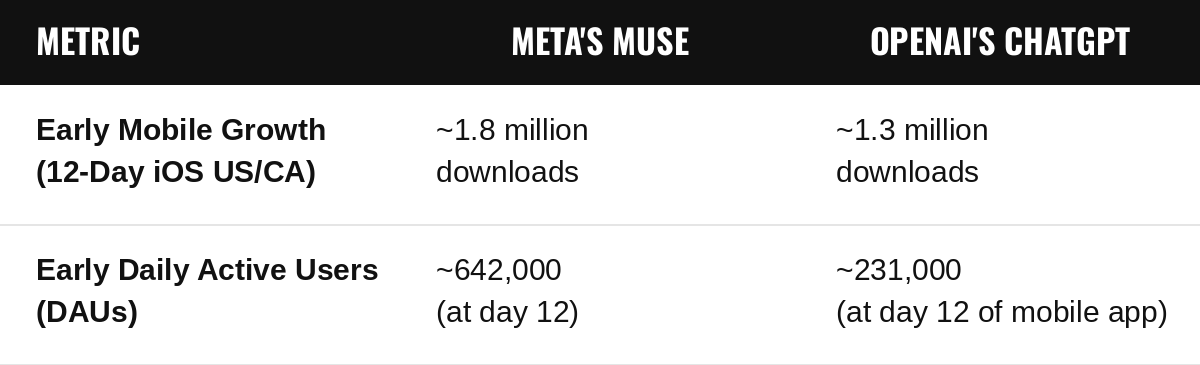
The rollout of Meta’s Muse AI agent on September 8 illustrates several factors in AI adoption.
Meta and Muse had at least three advantages going into that launch, compared to OpenAI and ChatGPT.
First, Meta has a massive distribution advantage, and can market directly to its 3.6 billion existing users.
Second, Meta’s public messaging was miles better than OpenAI or Anthropics’ has been. This extended down from CEO Mark Zuckerberg’s dismissal of “AI Doom” rhetoric, to the Labubu-esque Muse mascot.
Third, the Muse tool itself is designed, not to aspire to “artificial general intelligence” or “superintelligence,” but to help users manage real-world tasks.
Those advantages helped Muse outperform ChatGPT in early adoption. Critically, the tool seems to have drawn in first-time AI users, actually expanding the userbase relative to the frontier labs.
The Integration of Innovations
The diffusion of technological innovation has not fundamentally changed in the centuries since we defeated scurvy, because humans remain the determining factor. But diffusion and adoption have gotten faster.
Electronic communication, deeper social openness to change, global homogenization, and a shift toward software rather than hardware innovation have sped up the adoption of each successive wave of new technologies. The railroad and land-line phones took about 50 years to become widespread, while the personal computer was adopted in around 20 years, and the smartphone in less than a decade.
Artificial intelligence seems to be continuing that pattern, with usage of LLMs and similar tools skyrocketing from 3.8% of the U.S. in September of 2023 to 23.8% in September of 2026. However, just as with technological trends like Moore’s Law, adoption curves are not physical guarantees, but ultimately predictions that humans must fulfill for themselves. AI adoption faces the same fundamental obstacles to user adoption as any technology, including users’ economic and social circumstances, group beliefs, and even prejudices.
Economic studies of the adoption of new technology have identified factors such as cultural compatibility, the perception of relative advantage, and the visibility of a technology’s benefits as factors driving adoption rates. The personality of individual users (from “innovator” types down to “laggards”) is also a factor: continued growth of a new technology always requires making it increasingly accessible to slower adopters, as the Muse case illustrates.
Key Works and Concepts in Technological Adoption
Everett Rogers — Diffusion of Innovations (1962)
Rogers argues that the rate and success of adoption depend on five key attributes: relative advantage, compatibility, complexity, trialability, and observability.
Bruno Latour — Science in Action: How to Follow Scientists and Engineers Through Society (1987)
Scientific facts and technological artifacts, in Latour’s account, are implemented through "actor-networks." Part of the “action” of these networks is maintaining consensus around a technology - a continual process of social persuasion and reinforcement. Latour describes this consensus as building a “black box” around a technology: a universal shared understanding that marginalizes skeptics.
Bijker, Hughes, and Pinch (Eds.) — The Social Construction of Technological Systems (1987)
Technologies do not spread based purely on technical efficiency, the authors show; instead, they are shaped by interactions, and often conflict, among relevant social groups. We can certainly see this with “generative AI” in particular, which has triggered serious upheaval in the creative and culture industries, with social and professional forces limiting LLMs’ application in art, film, design, and writing.
Edwin Mansfield — The Economics of Technological Change (1968)
Mansfield focuses on the role of resource allocation and investment returns in turning science into useful technology. AI has already experienced multiple ‘winters,’ such as from 1974–1980 and 1987–2000, when hype gave way to disappointment, defunding – and a halt to progress that seemed inevitable.
Subscribe to Zero In to Receive Future Reports
AI Is a Communication Technology
Before becoming a journalist and analyst, David was a scholar of the history of technology - you can read about his very fun history of car audio here. That study focused on the way technology can be adopted to uses and meanings that its inventors never could have imagined.
The AI firms themselves have touted this mutable nature of technology as useful for their own growth. But some may have overindexed on the idea that AI is an endlessly transformable technology, accepting their own prediction of the machine’s universal, human-level intelligence as inevitable.
The reality, for now and the increasingly foreseeable future, is that AI is just software; That is, it is a technology with strengths, weaknesses, and limitations like any other. If you believe AI is going to cure all diseases within the next decade, you need to be able to describe how that will happen in some detail.
One way of articulating the mechanism of that process in detail might be to think of artificial intelligence, not as a semi-autonomous ‘mind in waiting’ that will somehow gain sentience if we keep poking it with a stick, but as a communication technology.
But instead of connecting people with one another, LLMs and related technologies primarily connect people with machines, or with a data archive.
LLMs are tools for communicating with, and transforming, the accumulated knowledge of the human species. They don’t have to be little gods in boxes - that’s impressive enough.
AI as Compression
One way of understanding AI is not just as a communication technology, but specifically as a compression technology. Many communication technologies are fundamentally about compression of data or inputs, from Morse code to the MP3 file format.
The push for compression accompanies increasing communication. “As people and institutions have developed new media … they have also sought out ways to build additional efficiencies into channels and to economize communication in the service of facilitating greater mobility,” as historian Jonathan Sterne writes.
In some sense, LLMs as a subset of “AI” can be understood as this kind of compression - in this case, not compression of data bandwidth on a physical medium, but of data bandwidth in individual human time, both on input and output.
Specifically, LLMs also act as a natural language interface that “compresses” the lengthy and arcane inputs of a command line into English; and in turn, as a summary and collation engine able to pull just the right data from just the right place and present efficiently compressed results.
AI as Hyper-Efficient Storage and Retrieval
On the output side, LLMs use the statistical distribution of symbols and their interrelationships as (in effect) an incredibly compressed storehouse of information collated, in the biggest models, from the entire universe of digitized information. This idea was summed up quite early in the process of AI adoption in Ted Chiang’s 2023 New Yorker essay “ChatGPT is a Blurry JPEG of the Web.”
This applies to any LLM model. Coding tools like Claude Code, for example, are themselves at root a vast interconnected archive of examples of code that works. They don’t actually store that code - a model’s “weights” are in a sense an incredibly compressed distillation of that data’s higher nature, rather than actual commands.
This means the tools inevitably work better on problems that are, in one way or another, “solved” at huge scale. Muse can build a website or Twitter header very well because it has lots of examples to draw inferences from. In coding, the results are best for routine tasks. For example, one 2023 study often cited for showed developers 55.8% faster with Claude Code measured a very common and routine task - building a JavaScript HTTP server.
LLMs have also been widely used for research, including as simply a more robust kind of web search that can organize results not just by relevance to a single search string, but by interconnections and specific themes or ideas in relation to a complex question.
This has shown massive benefits (and threats) to research roles such as consulting. As far back as 2023, one study of 453 college-educated professionals found they completed writing tasks 40% faster and at 18% higher graded quality - though these tasks were short and specific. More recently, a 2026 experiment by Dell’Acqua et al with 758 BCG consultants found that using an LLM helped them execute 12.2% more tasks, 25.1% faster, at roughly ~40% higher quality.
AI as “Lossy” Compression
However, that’s only half the story of the Dell’Acqua study. The efficiency gains came for tasks already within the LLMs training data. But the same study found that AI users trying to answer questions outside their model’s training data were 19 percentage points less likely to get the right answer.
This is because, just as a radio signal carries static and an MP3 has less richness than a .wav file, the “knowledge compression” of an LLM can be very “lossy.” Its “answers” are based on statistical relationships, not an actual archive of raw data, and reconstructing those relationships into source data can go wrong. We’ve come to refer to these LLM errors as “hallucinations.”
Those hallucinations are more common when a model has fewer examples of similar work in its data set, and this may prove one of the biggest long-term obstacles to LLM adoption for knowledge work and research at scale. Novice workers will not be able to recognize specific mistakes or hallucinations, because they themselves lack the knowledge to spot them. A human expert using an LLM will remain more effective than a human novice piloting the same model.
More fundamentally, many workers will not be able to spot the frontier of an LLM’s knowledge, and may continue to use it as a replacement for their own missing knowledge even when it is badly incorrect, or simply without meaningful substance.
This has manifested as “workslop,” or the mass adoption of LLMs for business communication. One study found this phenomenon actually damaging productivity, and 2026 has started to see signs that firms are skeptical of the usefulness of AI for all employees. Accenture, for example, just set tight constraints on AI budgets for most workers, an admission that AI does not magically and universally make workers more effective.
AI as Natural Language Interface
At Zero Knowledge, we make extensive use of LLMs as interfaces to complicated tools, especially those outside of our individual expertise.
One example is the design tool Figma, which has a powerful LLM interface that lets a user direct extremely fine adjustments to images or graphs using natural language tools. You can type “please change the font in this cell to 14 point bold,” or even “shift [x] five pixels upwards” and it just happens.
(Of course, not all LLM interfaces are useful. Squarespace’s, for instance, seems ineffective.)
Based on our experience, this is a use-case that can elevate a novice to an adequate or intermediate user. But many expert users will still prefer a graphic user interface for precision, and in many cases speed, compared to typed commands. Though possibly outdated by advancing technology, a 2025 METR study found that experienced coders working with a mature codebase worked 19% slower when using Claude Code.
Some of the sources of that slowdown are obvious: just like LLM ‘chatbots,’ LLM-based interfaces can take significant time to return results. So a truly expert human user of software like Excel or Figma still seems likely to outperform someone dependent on an LLM interface for even minor operations.
Studies of natural language interfaces have so far pointed to the value of a hybrid model, with applications offering both a GUI and an LLM-driven natural-language interface.
Key Readings oN Natural Language Interfaces
Cobus Greyling, “AI is the new human mediation layer”
Hans van Dam, Synergy of LLM and GUI, Beyond the Chatbot
Daniel Sannoma, “From Clicking to Talking”
AI as Question Decompression
The ability of a coding LLM to recombine and refine existing elements relies on hidden compression not just for “storage,” but also on the input side: the LLM is able to “explode” the constituent parts of a natural language request, breaking it down into specific steps and sub-questions that would normally remain implicit to a human.
There are limits to this 4k-Restoration-by-guessing-what-the-user-wants - just as an LLM can output a hallucination, some edge of its model will fail to understand a seemingly simple instruction.
This is one reason the emerging paradigm for the integration of AI as an interface is as a supplement to a traditional GUI. While natural language interfaces can bring a novice or unskilled user closer to average, a skilled user will still be faster, more precise, and more productive using a GUI.
AI as Computational Extension
Another compression in the AI workflow is the compression of computational power.
LLMs are no longer standalone word-clouds, but instead direct more predictable programs and perform (more) reliable calculation operations (the days of a pure LLM unable to add 2 + 2 reliably are essentially over). An advanced model being asked a Fields-medal mathematics question is able to connect the question to all the calculating power a human could dream of (if they can afford the tokens).
Equally important, AI models are able to execute against many possible answers to a computational question, or variations of that question, and expend the compute needed to decide whether each “path” is right or wrong.
It decompresses the question, then throws compute at every fractal implication within.
Math 2.0: AI Reshaping Human Research
A key example of AI as a “computational extension” and “question decompression” is unfolding before our eyes in the field of mathematics. A wave of claimed proofs pumped out by OpenAI have come into conflict with a complex system of verification and acceptance by existing mathematics professionals.
Mathematician Terence Tao’s “Math 2.0” thesis is an attempt to map this conflict and paths forward for the field in the age of AI. For now, it’s just a presentation with a slide deck on Github, but it offers critical insight into AI’s current and future role in advanced mathematics research.
Tao points out, most critically, that mathematics is particularly amenable to machine-learning approaches because of its “combination of objective verifiability, digitizability, and large, high-quality data sets.” Fields without those features will see fewer immediate real gains from AI tools.
Just as important, Tao also argues that these discoveries are not the “end of mathematics” that some have mourned. Instead, he argues that AI will expand and accelerate the scope of math by freeing up labor from mere proofs to higher and more abstract questions, such as which proofs actually matter.
This is a fairly clear example of a computer being very effective at calculation. But as Tao points out, human researchers will still be the ones directing all that calculation power - and spending their new free time doing even higher-level work.
Obstacles to AI Adoption: Historical Precedents
Everett Rogers and others have shown that appeals to even the most scientific evidence of the effectiveness or impact of a technology will not itself motivate a whole population to adopt it. Instead, awareness of cultural practices is essential - as much when discussing the use of AI in firms, as the adoption of snowmobiles in Lapland.
Rogers studies failed innovations as well as successful ones, to see where things can go wrong. One example is the Dvorak keyboard, an objective improvement on the QWERTY keyboard arrangement. Despite promised efficiencies, Dvorak has never really caught on. That’s in part because it requires retraining, but Rogers also finds it’s a structural issue: if you switch your own keyboard, you still have to use QWERTY keyboards out in the world - a kind of inverse network effect.
Another innovation that “failed” in a different way was the adoption of snowmobiles by traditional Lapp herdsmen in Finland. As Rogers details, the replacement of sled-based reindeer herding with the use of snowmobiles starting in the 1970s produced complicated transformations that ultimately destroyed reindeer herding as a way of life for the entire ethnic group, leaving them dependent on government subsidies.
Contemporary professionals are clearly more reflective about the potential of innovation to be harmful than Lappish herdsmen were in the 1970s. This is visible in public backlash over threats of job loss and other disruptions.
The frontier labs in particular may have harmed their own efforts by stoking those fears for many years with loud warnings of massive job loss.
Frontier Labs Believe in “Takeoff,” not “Adoption”
Surprisingly given their focus on innovation, the groups around OpenAI and Anthropic do not have a strong track record of fostering user adoption of new technologies.
One relevant example was a campaign to discourage meat-eating in Brazil, spearheaded by the “Effective Altruism” movement, whose tenets are almost universal within OpenAI and Anthropic. Effective Altruists working in Brazil promoted Impossible meat-replacement hamburgers as a way to discourage meat-eating. But the campaign reportedly failed because hamburgers are not a dominant food on the Brazilian menu. By ignoring the social reality on the ground, the EAs wasted substantial effort and resources.
EAs are part of a broader group who see AI in explicitly a-historical, nearly mystical terms. Instead of thinking about what specific groups might use LLMs for particular tasks in the present, thinkers like Ray Kurzweil and Eliezer Yudkowsky have advanced a theory of “The Singularity” or “rapid takeoff,” according to which AIs will suddenly, at some indeterminate point in time, begin self-improving at an accelerating rate, reach super-intelligence, and, essentially, take over the world.
This is more of a religious theory of innovation than a scientific or historical one: Kurzweil’s “Singularity” in particular replays Christian end-times stories, promising that the AI will resurrect the dead and create a kind of Heaven on Earth.
As fun as it has been for Silicon Valley philosophers to navel-gaze about for the past two decades, widespread belief in The Singularity may not help firms actually find customers.
Assuming that AI growth and adoption are simply inevitable reduces attention to actual applications, the real needs of users - and the many obstacles that stand between today and tomorrow.
